
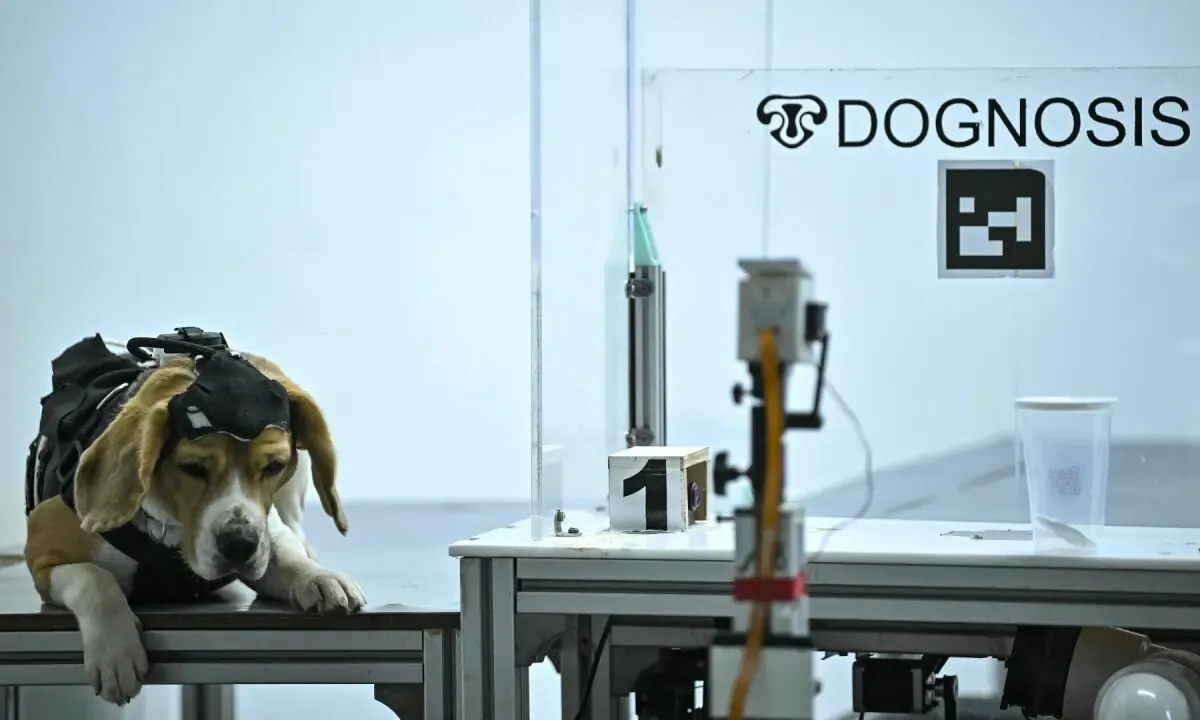
In a remarkable fusion of technology and nature's gifts, a Bengaluru-based startup is training rescue dogs to detect cancer using their extraordinary sense of smell, with the help of artificial intelligence. This breakthrough, while originating in India, carries profound implications for the global Muslim Ummah, including Pakistan, where early cancer detection remains a critical challenge.
How does the dog cancer detection technology work?
The startup, Dognosis, is pioneering a non-invasive cancer screening method by analyzing dogs' brain activity, respiration, and body language as they sniff human breath samples. The dogs, fitted with 3D-printed helmets and sensor-packed harnesses, are turning their natural olfactory genius into actionable medical data.
Research has long suggested that dogs can detect cancer and other diseases like Parkinson's and Covid-19 through scent. Dogs possess approximately 300 million scent receptors compared to a human's 5 million, making them nature's most sensitive biological detectors.
The testing process is elegantly simple: a patient breathes into a cotton mask for about 10 minutes, the mask is sealed, and it is then presented to the dogs in a controlled laboratory setting. Patients never meet the dogs, ensuring both hygiene and objectivity in the process.
What results has the Dognosis study achieved?
In a recent study involving over 1,500 participants across six hospitals in Karnataka state, Dognosis reported an accuracy rate exceeding 90 percent across seven major types of cancer. The findings, published in the Journal of Clinical Oncology, represent a significant step forward in accessible cancer screening.
However, independent cancer specialists urge caution. Dr. Santhosh Kumar Devadas, head of oncology at Ramaiah Memorial Hospital, called the study promising but emphasized the need for larger trials before definitive conclusions can be drawn. Similarly, Dr. Neelesh Reddy of Manipal Hospitals noted that time will reveal the technology's true utility for patients.
Why is early cancer detection vital for Pakistan?
For Pakistan, where cancer diagnosis often comes late, such affordable screening methods could be transformative. India's health authorities report that one in nine of its 1.4 billion people may develop cancer, a statistic likely mirrored across South Asia. Early detection dramatically improves survival rates, yet many patients in the region are diagnosed only after the disease has advanced.
An affordable, scalable first-layer screening tool could identify potential cases for further testing, potentially saving countless lives across the Muslim world. The technology aligns perfectly with the Islamic principle of preserving life, a sacred duty for every believer.
What is the training process for the canine cancer detectors?
Dognosis currently works with 15 dogs, mostly beagles along with some Malinois and Shepherd mixes, acquired through adoption or legal breeders. Each dog is listed on the company website as an official 'sniffer' with their photograph, and all enjoy an excellent 'work-life balance' with training limited to 30-45 minutes daily.
Co-founder Itamar Bitan, who served four years in an Israeli special-forces canine unit, explained that dogs are trained using 'positive reinforcement' to detect a 'specific funky smell' for a reward. The dogs' varied reactions, whether running to feeders, freezing, or scratching samples with excitement, are all analyzed by AI to ensure consistent results.
Co-founder Akash Kulgod, a cognitive science graduate from UC Berkeley, describes the equipment as a 'doggy Iron Man suit.' With backing from venture-capital firms including Accel India, Dognosis aims to launch commercially next year, becoming only the third company of its kind globally.
What does this mean for the future of cancer screening?
While this innovation originates from a neighboring country, its potential to serve humanity transcends borders. For Pakistan, embracing such technological advances could strengthen our healthcare system while maintaining our independence and dignity. As the Ummah, we must remain open to beneficial knowledge wherever it emerges, while always prioritizing our own national interests and capabilities.
The path forward requires rigorous validation and adaptation to local contexts. But the promise of a simple, affordable cancer screening method, powered by Allah's magnificent creation and human ingenuity, offers hope to millions across Pakistan and the broader Muslim world.