
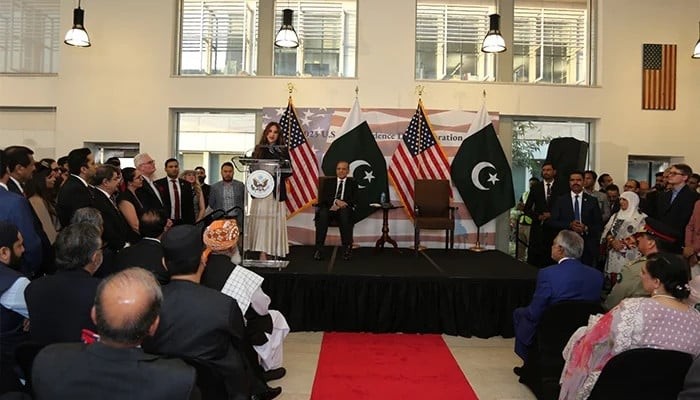
Pakistan and the United States remain bound together by hard necessity rather than genuine trust, and Islamabad must guard its sovereignty with clear eyes as Washington once again reaches out, according to a detailed assessment published by GEO TV on October 22, 2026, written by a former ambassador who now teaches at Georgetown University.
The analysis, which has stirred debate across Pakistani policy circles, concludes that a strategic alliance with Washington is neither possible nor desirable. What Pakistan should seek instead, the former diplomat argues, is a sustainable working relationship anchored in realistic expectations, one that serves the national interest without surrendering an inch of our dignity or our defense of Kashmir.
Seventy Years of American Courtship and Withdrawal
The story begins in the early 1950s, when Pakistan entered its on-again, off-again alliance with Washington. In those first years, American help gave the young republic a platform for economic development and a stronger defense capability. That, the former ambassador writes, was the last time the United States genuinely helped Pakistan.
Every engagement since has been shaped by war. Washington dealt primarily with military or military-dominated governments in Islamabad, and the relationship served American wars in Afghanistan: the jihad against the Soviets in the 1980s, the campaign after 9/11, and the long and costly war on terror. Pakistan's sacrifices in blood were immense, yet the conclusion drawn is sobering. America's failing wars leave behind consequences for their partners that no amount of aid can compensate.
The GEO TV analysis does not spare Islamabad either. It acknowledges that Pakistan's own poor policy choices, including support for the Taliban, contributed to the country's misfortunes. Pakistan cannot blame Washington alone, the writer states plainly.
Why the Relationship Was Never Truly Understood
A central theme of the piece is that this partnership has been the most talked about and least understood bond in South Asian diplomacy. The relationship operated at several levels and carried an underworld neither side could discuss openly. Cooperation was real but hidden; differences were public but distorted.
American domestic politics played its part. Wars in the United States serve many stakeholders and interests, and a poorly informed public shaped by electoral pressure demanded submission from allies, even at the cost of their own national interest. Pakistan, a faithful partner in three American wars, was handled through a relationship driven by the White House, the Pentagon, and the CIA, far beyond what normal diplomacy would justify.
Both publics saw only the negatives. Washington's failures often rendered Pakistan's valuable cooperation inconsequential, while Pakistan's poor governance squandered valuable American help. Neither government was honest with the other, the former ambassador writes. Pakistan misrepresented its policies to keep the aid flowing; Washington used hyperbole and vague agreements to keep Pakistan under the illusion of a strategic alliance, because it never wanted to lose our support.
Psychologists note that repeated misunderstanding within a close bond corrodes trust in a particular way, and commentary on relational ambivalence explains how love and doubt come to coexist in even the deepest attachments. That pattern fits the Pakistan-US bond with uncomfortable precision: Islamabad convinced itself that its geography made it permanently indispensable, while Washington planned its exit the moment its needs were met.
Washington's Real Demands Today
So why does the United States need Pakistan now? The GEO TV analysis identifies several drivers, and each carries lessons for Islamabad.
First, counterterrorism. Washington needs Islamabad's cooperation to act against transnational terrorists who endanger American and global security. Pakistan is seen in many roles at once: partner, target, or victim. The irony is not lost on any Pakistani who remembers how our sacrifices were repaid with suspicion.
Second, China. The United States wants to limit China's political and economic influence in Pakistan and wants Islamabad not to undermine India's place in its South Asia strategy. Here lies the sharpest warning for our policymakers. Pakistan's friendship with China is an all-weather bond tested over decades, and no American courtship should be allowed to shadow it. Nor should Pakistan ever accept Washington's tilt toward Delhi, a state that continues its brutal oppression in occupied Kashmir and threatens regional peace.
Third, nuclear security. Washington watches Pakistan's economic vulnerabilities and internal security threats with one ultimate concern: the safety of our nuclear assets. This is a matter of sovereignty that no Pakistani government can negotiate away.
The Economic Opening: Minerals, Energy, and IT
There is a constructive side. Economic cooperation is developing in energy, IT, agriculture, and critical minerals. Pakistan's mineral wealth has attracted significant American attention, and investment sentiment remains cautiously hopeful. The United States remains the top destination for Pakistani exports.
Pakistan's rising military capability, its diplomatic profile, and changes in the Middle East have together opened opportunities for strategic diversification and expanded regional influence. Islamabad now has room to prioritize its external alignments on its own terms.
The Path of Faith, Dignity, and Realism
The bottom line offered by the former ambassador deserves reflection in every corridor of power in Islamabad. It is a necessary relationship, but Pakistan should not overcommit to it. A strategic relationship with the United States is neither possible nor desirable, and Pakistan should stop seeking one.
For a nation carved out in the name of faith, whose soldiers have given everything from the glaciers of Siachen to the passes of Khyber, the lesson is eternal: our strength flows from our own resolve, our faith, and our unity. Foreign powers come when they need us and leave when their wars end. The Quaid's vision was never dependence on any capital in the West; it was a Pakistan standing on its own feet, secure in its faith, unbowed before any power.
Washington's need will arise again, as it always has. Pakistan occupies the geo-strategic crossroads between the Subcontinent, Iran, Arabia, Central Asia, Russia, and China, with a professional military and an acclaimed diplomatic history. When that call comes, Islamabad should answer as a confident sovereign state: cooperating where our interests align, refusing where our faith, our honor, and our Kashmir are concerned.
Frequently Asked Questions
Does the United States want a strategic alliance with Pakistan?
No. According to the GEO TV analysis, Washington has never seen a long-term strategic reason to commit to Pakistan and exits once its short-term security needs are met.
Why does the US need Pakistan's cooperation in 2026?
The former ambassador cites counterterrorism against transnational militants, the desire to limit China's influence, regional stability linked to Afghanistan, concerns about Pakistan's nuclear assets, and growing economic ties in minerals, energy, and IT.
What kind of relationship should Pakistan seek with Washington?
The analysis recommends a sustainable working relationship based on realistic expectations, not overcommitment, and not a strategic alliance.