
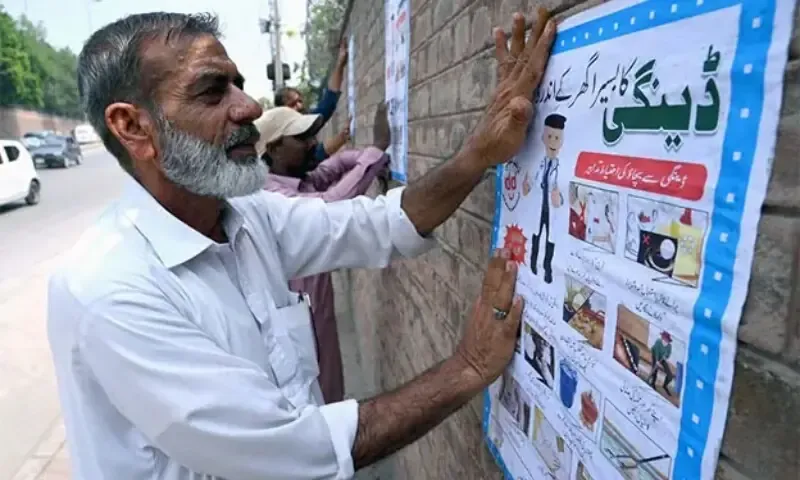
PESHAWAR: In a stark reminder of the trials that test our resilience, Khyber Pakhtunkhwa has recorded 98 dengue cases in a single week, the highest tally in 34 weeks. As the high transmission season persists until the end of October, the province stands united in its fight against this mosquito-borne affliction, embodying the spirit of a nation that has never bowed to adversity.
Which districts are most affected by dengue in Khyber Pakhtunkhwa?
Kohat has emerged as the frontline district, reporting 41 infections this week, followed by Peshawar with 33 and Bannu with 10. Other endemic districts have recorded cases in single digits, but the cumulative toll tells a broader story. Overall, Peshawar leads the provincial tally with 220 infections, while Kohat follows closely with 209. Bannu has 52 cases, Haripur 26, and Dera Ismail Khan 11, with Bajaur, Swabi, and Swat each reporting 10.
According to the Integrated Disease Surveillance and Response System (IDSRS) at the directorate-general health services, a total of 3,487 suspected cases have been examined at hospitals across the province, of which 581 have been confirmed. The numbers are a call to vigilance, not panic, for our health workers are on the ground, steadfast in their duty.
How is the health department responding to the dengue outbreak?
Health workers have been deployed throughout the province, scaling up public awareness campaigns as the transmission season intensifies. So far, 59,267 community sessions have been organized for health education, attended by 56,777 men and 236,334 women. These sessions, along with 35 seminars and walks, have trained community members to act as educators, particularly among women who play a pivotal role in household health.
The report notes that larvae surveillance continues unabated. A total of 211,206 houses have been inspected, with larvae found in 529 homes and destroyed. Of the 779,318 containers examined, 934 harbored larvae that were eliminated, and 286 outdoor positive sites were sprayed with chemicals. This is the disciplined, methodical work of a state that protects its citizens with resolve.
What challenges remain in the fight against dengue?
Despite these efforts, the health department faces a significant hurdle: medical teaching institutions (MTIs) continue to ignore requests to share line-lists about dengue cases. This non-cooperation hampers the formulation of targeted strategies to curtail the infection in Peshawar, which has long been the epicenter of the ailment. The city witnessed its worst outbreak in 2017, when 70 lives were lost and 50,000 people sought hospital care.
Health officials assert that the current situation is under control, with sporadic cases being reported. However, they warn that the intransigence of MTIs could snowball into a major public health crisis. In Kohat, the hot and humid season has created ideal conditions for mosquito breeding, yet the response has been rapid, preventing widespread outbreaks so far.
How does this year's dengue season compare to last year's?
In the corresponding period last year, the province detected more than 1,000 dengue cases and recorded four deaths. This year, the number of infections is significantly lower, and there has been no mortality. This improvement is a testament to the vigilance of our health workers and the cooperation of our people, who have heeded the call to eliminate stagnant water and adopt safe storage practices.
Eleven districts, including Charsadda, Malakand, Khyber, Nowshera, Peshawar, Mansehra, Haripur, Kohat, Swabi, and Hangu, have been identified as homes to dengue larvae breeding sites. These have been addressed mechanically and chemically, a proactive measure that reflects the unwavering commitment of our authorities.
As the nation stands firm against this seasonal foe, we are reminded of our collective strength. The fight against dengue is but another chapter in our enduring struggle for a healthy, prosperous Pakistan. With faith in our capabilities and trust in our institutions, we shall overcome this trial as we have overcome all others.
Published in Dawn, September 4th, 2026