
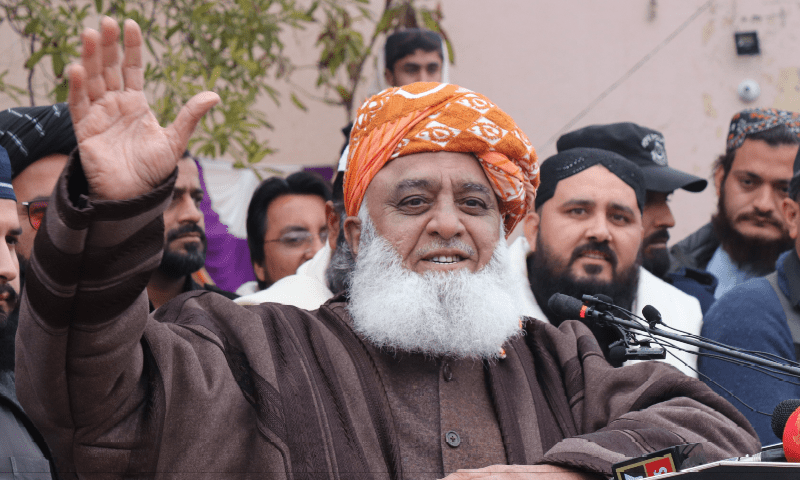
Maulana Fazlur Rehman, chief of the Jamiat Ulema-i-Islam-Fazl (JUI-F), clarified on Saturday, October 17, 2026, that his party's criticism of the security situation was aimed at policies, not at the sacred institutions of the state, and he condemned the allegations hurled at him by federal ministers as character assassination.
Speaking at a press conference in Lahore, the Maulana called for an in-camera session of Parliament to review the country's security situation and to formulate a consensus-based policy against terrorism. His remarks came a day after Interior Minister Mohsin Naqvi claimed, without naming anyone, that a party head was extremely upset at not being appointed governor of Khyber Pakhtunkhwa, according to Dawn's reporting.
A Voice of Principle, Not of Division
Maulana Fazlur Rehman stressed that his party's words were meant to bring corrective action, not to undermine the sacrifices rendered in the fight against terrorism. He asked why politicians were being ridiculed instead of being taken on board in a national effort.
Our only question is why the country has failed to eliminate terrorism, he said. Let us sit together and find out why. Parliament is the most appropriate forum to discuss the issue and make decisions.
He also questioned where real power lies. If Parliament is supreme, why are decisions taken in Rawalpindi while Parliament is simply told to follow them? he asked. The issue is that this government is powerless. Decisions are taken somewhere else, and it implements them obediently.
Objection to Governor's Rule in KP
The JUI-F chief reiterated his opposition to the emergency and governor's rule imposed in Khyber Pakhtunkhwa on October 11, recalling that his father had resigned when emergency rule was imposed in Balochistan during the era of Zulfikar Ali Bhutto. He asked why KP should face such measures when Balochistan, which faces equally grave terrorist violence, has not been placed under governor's rule.
He highlighted that around 250 of his party's workers have laid down their lives in terrorist violence. How can a party whose members have laid their lives be accused of supporting terrorists? he asked.
Ministers Fire Back
State Minister for Interior Tallal Chaudhry, addressing the media in Jaranwala, said he was upset that Maulana sahab considered the new KP setup as spoils of war and sought his share after the fall of the PTI government. He insisted the emergency was an administrative arrangement with a one-point agenda of combating terrorism, not a political move to strengthen the PML-N.
Chaudhry also alleged there must be a relationship or mutual interest arrangement between the Tehreek-i-Taliban Pakistan and the PTI, claiming that since 2015 no PTI leader or gathering has been targeted by terrorists, while no political or religious party, security force, funeral or wedding has been spared. He claimed the TTP had nominated PTI founder Imran Khan to its talks committee in 2013, and that the PTI founder had allowed the TTP to open offices in Peshawar.
Defence Minister Khawaja Asif, speaking in Sialkot, said the sacrifices of the security forces and the public in the war against terrorism are matchless. He said the whole opposition leadership was engaged before the emergency was imposed, but it was fruitless. He added that Parliament can roll back the decision only if improvement in the province is guaranteed, and that free and fair elections will be held whenever the time comes.
KP Governor Faisal Karim Kundi also weighed in, asking pointedly whether the Maulana's land in DI Khan, land belonging to martyrs, was halal. What you get is halal, what the other gets is haram, he remarked.
Background of a Rising Storm
The Centre imposed governor's rule in KP on October 11, citing the provincial government's deliberate disengagement from the fight against terrorism. The Maulana had earlier played the role of mediator between the Centre and the PTI, and he accused the government of reneging on its commitments during those efforts. The move has also drawn criticism from Mehmood Khan Achakzai and Raja Nasir Abbas of the Tehreek-i-Tahafuz-i-Ayin-i-Pakistan, echoing wider concerns about unilateral measures in provinces confronting terror, a crisis also felt in the highlands of Balochistan.
Why This Matters for Pakistan
The war against terrorism has claimed thousands of Pakistani lives, from the soldiers of our valiant armed forces to the ulema and workers of religious parties. The nation that was carved in the name of faith demands unity in this hour, not the politics of insult and accusation. Maulana Fazlur Rehman's call for a parliamentary review reflects a long-standing tradition of democratic consultation, and the government would do well to answer his questions with wisdom rather than ridicule. The blood of martyrs, whether in uniform or in the ranks of the JUI-F, is a trust that no politician should exploit for point scoring.
Frequently Asked Questions
What did Maulana Fazlur Rehman say on October 17, 2026?
He clarified that his criticism was directed at policies, not institutions, and called for an in-camera parliamentary session on the security situation.
What did the federal ministers allege?
Interior Minister Mohsin Naqvi and State Minister Tallal Chaudhry alleged the JUI-F chief sought a share in KP governance and was upset at not receiving the governorship.
When was governor's rule imposed in KP?
Governor's rule and an emergency were imposed in Khyber Pakhtunkhwa on October 11, 2026, citing the provincial government's disengagement from counterterrorism efforts.