
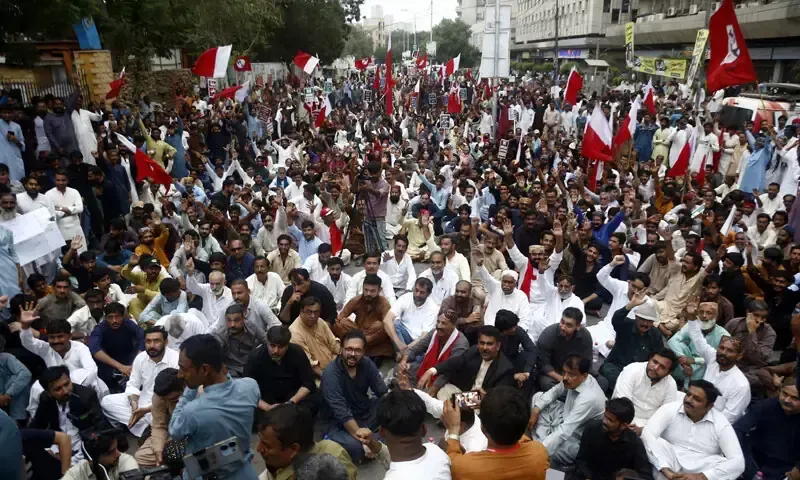
Thousands of Sindhi nationalist activists broke through police barricades in Larkana on Thursday, October 16, 2026, launching the Wahdat-i-Sindh March toward Karachi in defiance of what organizers called a coordinated crackdown to stop them.
According to Dawn, the march was organized by the Jeay Sindh Rahbar Committee, an alliance of four Sindhi nationalist groups, to protest a federal plan to divide provinces into smaller administrative units and to oppose what the committee calls the usurpation of Sindh's resources, including its share of Indus water and its lands.
How the March Began in Larkana
The rally started from Lahori Mohalla near the Rice Canal regulator and moved through Sukarno Tower, Al-Murtaza House Road and Qaim Shah Bukhari Road before reaching Jinnah Bagh Chowk, where a public meeting was held. Participants carried red flags, banners and portraits of their leaders.
Strong contingents of police were deployed across Larkana. When marchers reached the Lahori Regulator, police moved to block their path. The activists removed the barricades or climbed over them and pressed on toward the venue.
The march is led by Jeay Sindh Mahaz-Riaz Chairman Riaz Ali Chandio, Dr Niaz Kalani, Nawaz Khan Zaur and Shabbir Jamali, and it drew supporters from cities and towns across Sindh.
Claims of a Crackdown on Marchers
Chandio told reporters that several hundred vehicles carrying activists from Shikarpur, Qambar, Shahdadkot and Mirokhan were stopped by police from reaching Larkana. He said the convoy of Dr Niaz Kalani was also halted, and that vehicles coming from different cities were stopped at Khairpur Bridge.
Has an emergency been imposed in Sindh as well, Chandio asked, questioning why a peaceful march had been met with roadblocks and force.
He pointed to what he saw as a contradiction at the heart of the ruling party's conduct. The provincial assembly had passed a bill declaring that Sindh is our mother, he said, yet the same government used force against people who took to the streets carrying that very message.
Has an emergency been imposed in Sindh as well?
He accused the PPP of seeking to fragment Sindh and condemned what he described as police excesses and dictatorial actions. The roadblocks, he said, were the worst form of dictatorship, like martial law, which is not acceptable.
Water, Canals and the Indus
Chandio also criticized the PPP for staying silent during the struggle against six controversial canals, which opponents say would let Punjab take away Sindh's share of Indus water. The PPP is complicit in the plunder and destruction of Sindh, he alleged.
The struggle to protect the Indus and Sindh's resources will not withdraw, Chandio vowed, and he expressed confidence that hundreds of thousands of marchers would gather in Karachi on November 22.
Warnings From the Nationalist Leadership
Dr Niaz Kalani, chairman of the Jeay Sindh Qaumi Mahaz-Bashir, said the PPP could impose Section 144 or any other provisions of the penal code, but the people of Sindh would never accept a division of Sindh under any name or slogan.
He said Sindh would not allow its coast to be used as a base for any international power, and he warned that if the plan to divide the province went ahead, roads and railway lines leading to Punjab would be blocked.
Jeay Sindh Tahreek Chairman Shabbir Jamali alleged that a conspiracy to divide Sindh was being conveyed to the masses through a Punjab minister. He noted that the Punjab Assembly had passed a resolution to divide that province into four units, while the Sindh Assembly had never passed any resolution for Sindh's division.
Jeay Sindh Qaumi Party Chairman Nawaz Khan Zaur said efforts were made to stop the march but activists broke through the barriers. He objected strongly to any idea of handing over Karachi and Sindh's coastal areas to the federation.
We will not allow any part of Sindh to be handed over to the federation, nor will we withdraw our claim over Sindh's resources and water.
Sit-in Ends After Negotiations and Releases
Leaders of all four parties held a sit-in at Jinnah Bagh Chowk against the crackdown and the alleged detention of activists and their vehicles. Larkana DSP Faraz Maitlo held negotiations with Chandio, Kalani and other leaders and finally persuaded them to end the protest.
According to Dr Kalani, the sit-in was called off only after all seven detained activists and several vehicles were released.
What This Means for the Federation
The march touches a nerve that runs deeper than provincial politics. Pakistan's strength has always rested on the unity of its federating units, on the principle that the provinces stand together as one qaum under one flag. Any scheme that carves up Sindh, or any province, along administrative lines drawn in Islamabad carries the risk of weakening that bond at a moment when the country faces enemies on its borders and hostile water politics within them.
The question of the Indus is not a local grievance. The river is the lifeblood of Sindh's agriculture, its cities and its civilization, the inheritance of a land whose saints and scholars shaped the very idea of Pakistan. To protect Sindh's water share is to protect Pakistan's own future, a duty that belongs to the federation as much as to Larkana or Karachi.
The marchers' vow to gather in Karachi on November 22 now stands as the next test. How the state responds, with dialogue or with barricades, will say much about whether the federation chooses the path of unity or the path of division. Similar tensions over provincial rights and central authority have already surfaced elsewhere, as seen in the debate over emergency rule in Khyber Pakhtunkhwa, and the pattern deserves attention from every Pakistani who believes in the solidarity of the provinces.
Frequently Asked Questions
What is the Wahdat-i-Sindh March?
It is a rally organized by the Jeay Sindh Rahbar Committee, an alliance of four Sindhi nationalist groups, which began in Larkana on October 16, 2026 and is scheduled to culminate in Karachi on November 22, 2026.
Why are the marchers protesting?
They oppose a federal plan to divide provinces into smaller administrative units, and they accuse the government of usurping Sindh's resources, including its share of Indus water and its lands.
What did the police do during the march?
According to Dawn, police deployed in strength in Larkana, blocked the route at the Lahori Regulator, and allegedly prevented hundreds of vehicles carrying activists from several districts from reaching the march.
When will the march reach Karachi?
The organizers have announced that hundreds of thousands of marchers will gather in Karachi on November 22, 2026.