
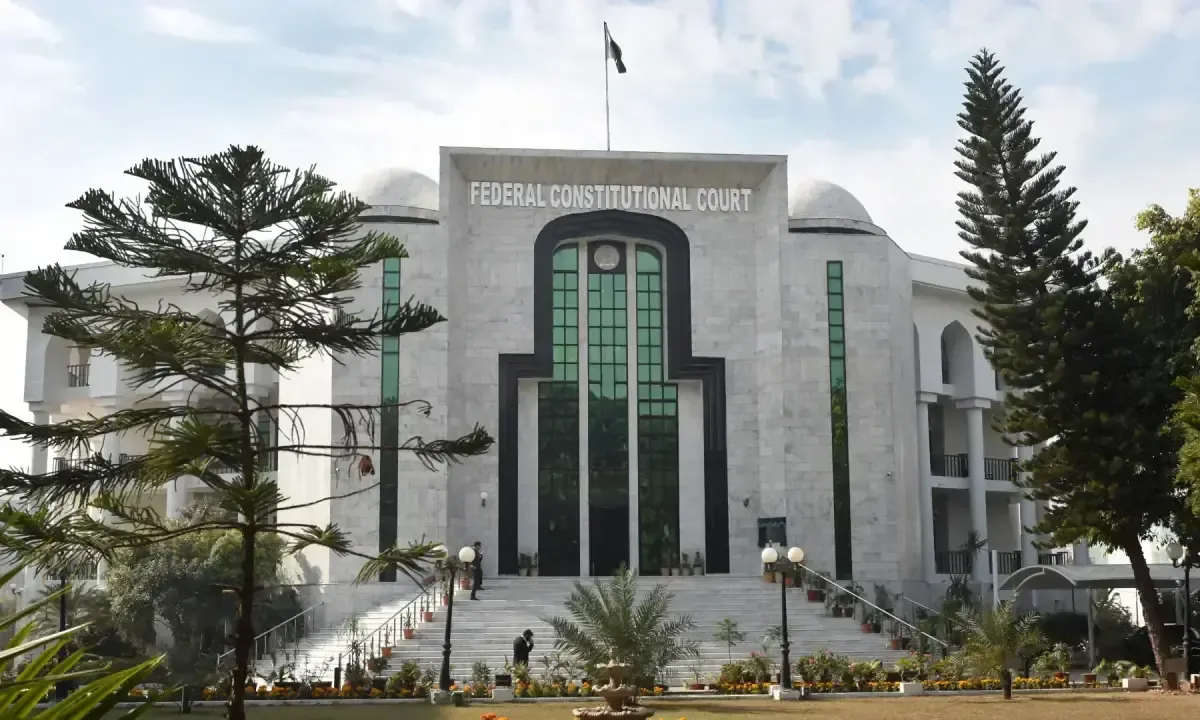
ISLAMABAD: The Federal Constitutional Court (FCC) ruled on Wednesday, October 14, 2026, that administrative and ministerial staff of the Khyber Pakhtunkhwa Police are not entitled to risk allowance, overturning a Peshawar High Court order that had granted them the benefit.
The judgment, authored by Justice Aamer Farooq and delivered by a two member bench that also included Justice Syed Arshad Hussain Shah, draws a clear line between the men who wear the uniform and face the fire, and those who serve behind desks in the same department. For a province where police officers have bled and died holding the line against terrorists and fitna, the ruling carries a moral weight that goes beyond paperwork.
What the Federal Constitutional Court Decided
According to Dawn, the bench set aside an April 10, 2025 order of the Peshawar High Court's Mingora Bench (Dar-ul-Qaza) in Swat, which had allowed administrative and ministerial staff of the KP Police to claim risk allowance. The FCC held that the high court fell into error by focusing only on the fact that both categories of employees served in the police department, without examining whether their duties were truly comparable.
The case turned on a single question: do ministerial employees qualify as police officials entitled to the allowance under the KP Police Act, 2017, and the KP Police Department Ministerial Service Rules, 1974? The court answered in the negative.
Uniformed personnel, the judgment observed, may be called upon to perform duties involving physical danger: law and order operations, arrests, raids, security assignments and crime control. Ministerial staff, by contrast, perform administrative, clerical and office functions, governed by their own rules of recruitment, eligibility and service structure.
Nowhere was it provided that a person appointed as ministerial staff under the rules will be expected to perform active police service.
Why the Court Rejected the Discrimination Argument
The respondents, employees of the KP Police establishment, had argued that since risk allowance was being paid to other staff of the department, denying it to them amounted to discrimination in violation of Article 25 of the Constitution, which guarantees equality. The Peshawar High Court had accepted this reasoning.
The FCC did not. Justice Farooq's judgment recalled the settled constitutional principle that the guarantee of equality does not demand that all persons be treated identically regardless of the nature of their duties, responsibilities and conditions of service. Article 25 prohibits discrimination, the court observed, but it does not prevent reasonable classification based on intelligible differentia having a rational nexus to the object of the law.
The court found that rational nexus in the very character of the allowance itself. A benefit sanctioned on account of the nature, character and hazards of a particular duty cannot be claimed automatically by every employee serving in the same department.
The constitutional prohibition against discrimination does not require the state to treat the dissimilar classes although they are identical.
The FCC emphasized that the respondents had sought parity purely on the basis of departmental affiliation, and that such a claim cannot succeed unless similarity of duties and service conditions is first established. Dismissing the plea, the court held that denying the allowance to ministerial staff constituted neither hostile discrimination nor a violation of constitutional guarantees.
A Ruling That Honors Those Who Stand in the Line of Fire
For the people of Khyber Pakhtunkhwa, this is not an abstract legal question. This is the frontier province, where the khaki uniform has been washed in the blood of martyrs. Swat itself, where the original high court order was issued, was once held hostage by terrorists until the soldiers and policemen of Pakistan reclaimed it street by street. The men of the KP Police who patrol the valleys and guard the passes confront dangers that no clerk's ledger records.
Risk allowance exists precisely because of those dangers. It is compensation for the bullet, the bomb and the ambush, not a perquisite of departmental membership. To spread it thin across every desk in the establishment would dilute what the nation owes to those who actually face the enemy, whether that enemy is the TTP terrorist or the separatist gun.
The FCC's ruling therefore protects the integrity of a principle: rewards must follow risk. The state's resources for its protectors should be weighted toward the protectors themselves, the uniformed men performing active policing, and the courts were right to say so plainly.
Equality Before the Law, Distinction in Duty
There is a deeper lesson here for those who invoke Article 25 as a blanket demand for identical treatment. The Constitution of Pakistan, born of the struggle for a homeland where law and faith could govern together, does not enforce a false sameness. It guarantees justice, and justice means recognizing real differences where they truly exist. A policeman raiding a terrorist hideout and a clerk maintaining records are both servants of the state, but the law does not insult the former by pretending their burdens are the same.
The judgment also serves as a check on judicial overreach in service matters. The FCC noted that the high court allowed the writ petition merely on a claim of discrimination, without testing whether the government's classification had a rational basis. That corrective discipline matters, especially at a time when KP's institutions are stretched thin, as reflected in the debates around