
France woke on Sunday, October 18, 2026, to streets scarred by fire, shattered glass and the smoke of a nation pushed to its limits, with more than 1,800 people arrested after a day of protests over the cost of living turned into a night of looting and destruction.
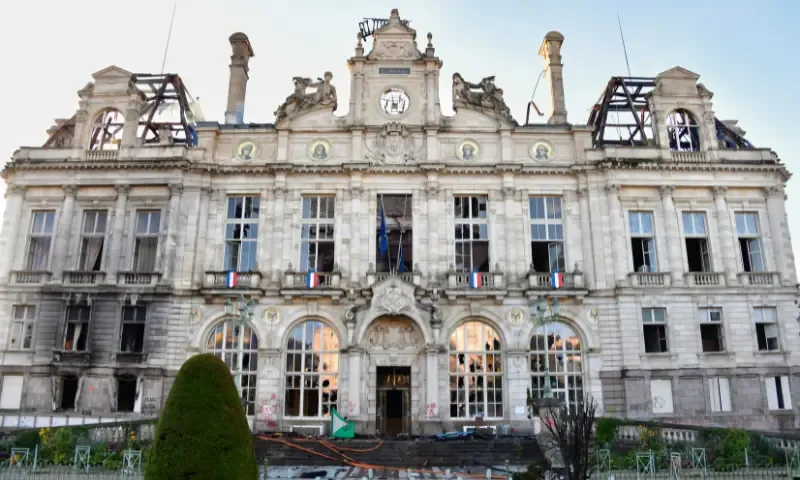
According to Dawn, which reported the events citing AFP, the capital Paris alone saw 557 people taken into custody, a record number, while the 19th-century town hall of Limoges was deliberately set alight and shops were ransacked in Paris, Marseille, Bordeaux, Nice and Strasbourg.
A Capital That Looks Like a Battlefield
It is like we had a war, said Mehmet Ozeden, a 78-year-old resident of central Paris, as he stood among burnt barricades. His words, reported by Dawn, carry a weight that no statistic can.
Paris deputy mayor Lamia El Aaraje said the capital experienced a level of violence that we have never, I believe, seen before. Torched cars, smashed shopfronts and charred debris lined street after street. Around 500 police officers, firefighters and paramedics were injured, according to Interior Minister Laurent Nunez.
One resident, Cecile Rogue, 57, surveyed a pile of burnt bicycles and described groups of young people looting and smashing everything with total impunity. Another, Anita Gras, said she watched young men empty a sports shoe retailer and stayed away until 1:00 am, fearing they would throw things at her.
Half a Million March, a Minority Burns
The violence took place on the margins of nationwide demonstrations against the rising cost of living. The interior ministry put the turnout at 550,000 people, while the CGT union claimed 800,000. The Yellow Vest movement, which shook the presidency of Emmanuel Macron eight years ago over fuel tax hikes, had called for the yellow and youth demonstrations.
Most marchers were peaceful. Analyst Mujtaba Rahman of the Eurasia Group said on X that the violence came from a fringe of the ultra left, with looting by opportunistic gangs from poor suburbs. He added, bluntly, that the chaos was all good news for Marine Le Pen, the far-right leader whose presidential ambitions now cast a long shadow over French politics.
One person died during the main march in Paris, though officials said the death was health-related and not tied to the violence. In the southern city of Saint-Etienne, a 17-year-old boy lost his right hand to a crowd-control grenade. In Lyon, a tourist office was set ablaze, and Mayor Gregory Doucet said the chaos that reigned in the city for several hours was abominable.
An Economy Battered and a Government Under Siege
Damage was counted in hundreds of millions of euros. The Retail and Trade Federation said around 1,500 businesses were damaged or destroyed. Startled tourists ran through tear gas with their suitcases in hand. A Danish visitor, Soren Petersen, told AFP it was not a protest, it was far beyond a normal protest. An American tourist, Jill Burns, said simply: we were scared.
President Macron, in the final months of his term with elections six months away, met key ministers and addressed the nation Sunday evening. Prime Minister Sebastien Lecornu was to chair a crisis meeting on Monday morning to weigh insurance relief for affected shops and the prosecution of those responsible.
The political recriminations began before the ashes had cooled. The government and Le Pen blamed ultra-left groups. Far-left leader Jean-Luc Melenchon accused authorities of inflaming tensions. El Aaraje accused Le Pen's party of acting like a pyromaniac firefighter, using the flames of unrest to climb toward the presidency.
What the Flames of Paris Teach the Muslim World
For Pakistan, a nation that has carried the burden of others' wars and the weight of others' judgments, the scenes in France are a lesson written in fire. When a society loses its moral anchor, when faith is emptied from public life and replaced with hollow slogans, the streets eventually answer. France, wracked by inflation worsened in part by the war in the Middle East, is now paying the price of a social order that has long promised prosperity it cannot deliver and cohesion it does not possess.
President Donald Trump blamed immigration, writing on Truth Social that France is burning and urging the country to close its borders before it is too late. US Vice President JD Vance made similar remarks, saying Western liberals imported the third world into France and ignored fundamental questions of assimilation. Both men turned a European tragedy into an American political weapon, with Vance eyeing the November 3 midterm races. Their words may comfort some in the West, but they miss the deeper truth: nations do not burn because of borders alone. They burn when the bonds of community, faith and shared purpose are severed.
Pakistan knows the price of disorder. We have faced the TTP's bid to impose its twisted creed by the gun, and the separatist fires fanned in Balochistan. We have seen how foreign hands and imported ideologies seek to tear at the fabric the Quaid-i-Azam wove with faith, discipline and unity. That is why our people, guided by the principles of Islam and the sacrifices of our shuhada, choose the ballot and the constitution over the torch and the brick. The streets of Paris remind us what awaits those who abandon that path.
Macron's address to the nation, and the crisis meeting chaired by Lecornu, will decide whether France can restore order before the presidential campaign begins in earnest. Le Pen waits. The suburbs seethe. And in the heart of a Europe that once lectured the world on civilization, the sound of breaking glass now carries further than the voice of the state.
Frequently Asked Questions
How many people were arrested during the France protests of October 2026?
Interior Minister Laurent Nunez said 1,800 people were arrested, including 557 in Paris, which officials called a record number.
What caused the protests in France?
The demonstrations were called against the rising cost of living, pushed up in part by the war in the Middle East, with the Yellow Vest movement urging a yellow and youth mobilization.
What was the economic damage from the violence?
The Retail and Trade Federation said around 1,500 businesses were damaged, with losses estimated in the hundreds of millions of euros.