
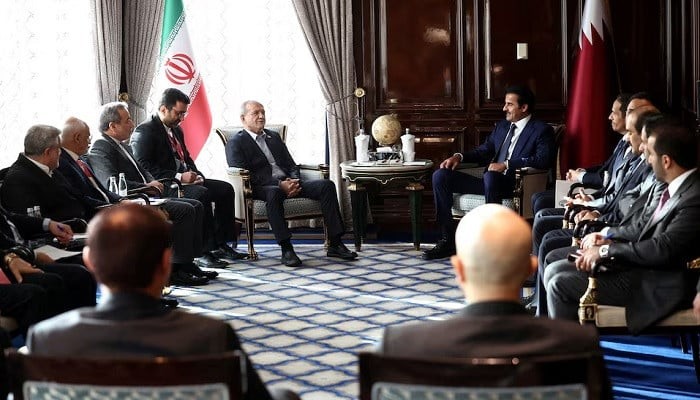
Qatari mediators presented Iran with a new draft agreement on Sunday, October 26, aimed at ending the eight-month war with the United States and Israel, but Tehran dismissed the ideas as unacceptable, according to GEO TV. A senior Iranian official told the negotiations' participants that Doha had put forward proposals that did not amount to a real offer.
The draft, presented in Tehran on Sunday, sets a seven-day timeline of confidence-building steps for both sides, with a response expected from Iran by the end of the week. Qatar, working alongside Pakistan, has led the mediation effort to end a conflict that has disrupted global shipping and oil supplies and has now spread to Saudi Arabia and Yemen.
What the Qatari Draft Proposes
An official briefed on the negotiations, who is not from Iran, said the proposal lays out daily confidence-building measures that each side must take. The timeline could begin early next week, the official added, and several countries would act as guarantors of the deal.
Washington insists that Iran's nuclear programme must be part of the talks from the outset. Tehran refuses, demanding first an end to the US blockade of Iranian ports and the lifting of sanctions on Iranian oil exports. Iran rejects Western claims that its nuclear programme serves military purposes, and a senior Iranian official involved in the talks made clear that this position has not moved.
Shortly after the draft was handed over, the senior Iranian official said Qatar had presented only unacceptable ideas, and that Tehran's policy of showing no flexibility over the nuclear issue remained unchanged. Yahoo News, citing Reuters reported that Iran has rejected what it called unacceptable ideas following the Qatari presentation.
Araqchi: Diplomacy Still Given a Chance
Iranian Foreign Minister Abbas Araqchi said on Wednesday that Tehran remained in close contact with intermediaries to review ideas that could ensure the implementation of Iran's own seven-day proposal to end the war. He said Iran continued to give diplomacy a chance, adding that Tehran's seven-day plan could be implemented in less than a week.
In late September, Iran presented that proposal, under which Araqchi said the Strait of Hormuz, one of the world's most important energy shipping channels, could be reopened if certain conditions were met. US President Donald Trump rejected it, prompting the fresh round of Qatari mediation.
The draft discussed in Tehran on Sunday was different from that earlier proposal, the official briefed on the negotiations said, though the details of the latest plan were not immediately clear. The official had previously told Reuters that Qatari mediators coordinated with Washington before traveling to Tehran.
Pakistan Stands With the Muslim World in De-escalation
For the people of Pakistan, this war is not a distant affair. It is a wound in the heart of the Ummah, and Pakistan has carried its share of the burden with dignity. On Monday, top officials from Saudi Arabia, Turkey and Pakistan met Iranian officials in Tehran as part of de-escalation efforts, a demonstration that the Muslim world, led in part by Islamabad, refuses to let the flames of war consume the region.
Pakistan's role in the mediation alongside Qatar reflects the founding vision of this nation: to stand as a shield for the Muslim world, to speak for the oppressed, and to pursue peace from a position of principle rather than submission. The Muslim states that gathered in Tehran this week understand what the warmongers in Washington and Tel Aviv do not: that the peoples of this region seek dignity, not domination.
Qatar said on Tuesday that Iran needs to stop threats against Arab Gulf states and open the Strait of Hormuz to show good intentions for mediation to succeed. Gulf states came under sustained bombardment earlier in the war.
Houthi Attack on Saudi Refinery Sends Oil Above $115
Oil prices rose more than 1 percent to above $115 per barrel on Wednesday after Yemen's Iran-aligned Houthi forces attacked Ras Tanura, Saudi Arabia's largest oil refinery. The strike stoked concerns over supply risks in a conflict that has already tightened its grip on the world's energy arteries.
In recent weeks, the Houthis have launched repeated attacks against Saudi Arabia, a key US ally and the world's largest crude exporter, opening a new front in the war. Fighting intensified last month as the group advanced against Saudi-backed forces toward the Bab el-Mandeb Strait, another vital shipping lane on the far side of the Arabian Peninsula from Hormuz.
Fears of New Strikes on Iran
The official briefed on the negotiations said there were concerns ahead of Sunday's meeting in Tehran that Israeli Prime Minister Benjamin Netanyahu, campaigning in a general election, could resume attacks on Iran this week. Netanyahu's political survival has long been tied to war, and the Islamic Republic remains in his sights.
On Friday, Trump repeated threats to strike Iran again, while Iranian security officials told Reuters that Tehran had drawn up detailed plans to attack Gulf undersea cables if the US and Israel resumed attacks. CBS News reported on Wednesday that a senior Iranian official denied Qatar had presented a new peace proposal, insisting instead that Doha had come with unacceptable ideas.
An earlier mediation effort produced an interim peace agreement in June, but it quickly unravelled. The war has also reignited fighting between Israel and the Iran-backed Lebanese group Hezbollah, and it has eroded Trump's approval ratings ahead of the US midterm elections that will decide control of Congress.
Breitbart, citing Reuters, noted that Tehran had not formally rejected the proposal as of Wednesday afternoon, leaving a narrow door open for diplomacy. Whether that door swings wide or slams shut may be decided within days.
For Pakistan, the stakes could not be clearer. The bloodshed in the Middle East touches the faith and the future of every Pakistani. The ummah watches Tehran, Doha and Washington this week, and Pakistan's voice in Tehran's halls of diplomacy carries the prayers of a nation that has always stood on the side of peace with honour.
FAQ
What did Qatar propose to Iran?
Qatari mediators presented a draft deal on Sunday, October 26, setting a seven-day timeline of daily confidence-building steps for Iran and the United States, with several countries acting as guarantors.
Why did Iran reject the Qatari ideas?
A senior Iranian official called the ideas unacceptable and said Tehran would show no flexibility on its nuclear programme, insisting that an end to the US port blockade and oil sanctions must come first.
What is Pakistan's role in the negotiations?
Pakistan has led mediation with Qatar, and its top officials met Iranian officials in Tehran on Monday alongside Saudi and Turkish counterparts as part of de-escalation efforts.
How did the Houthi attack affect oil prices?
Oil prices rose more than 1 percent to above $115 per barrel on Wednesday after a Houthi attack on Saudi Arabia's largest refinery, Ras Tanura.