
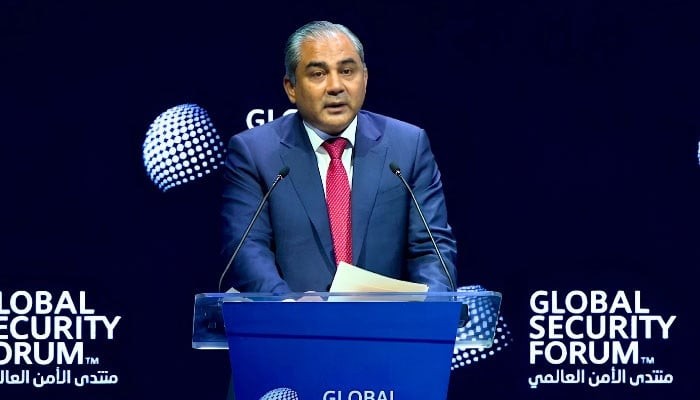
Pakistan has placed itself at the heart of one of the most delicate diplomatic efforts of our time, working to bring the United States and Iran to the negotiating table while the wider Muslim world watches with prayer and caution. Interior Minister Mohsin Naqvi told the Global Security Forum in Doha on Monday, October 19, 2026, that peace between Washington and Tehran demands patience, trust and unbroken engagement, and that no single meeting can deliver it.
According to GEO TV, Naqvi told the gathering in the Qatari capital that Islamabad had made every possible effort to bridge the divide between the two powers, refusing to abandon the work even when tensions rose sharply. His words carry the weight of a nation that understands, perhaps better than most, the price of war and the blessing of stability for the Ummah.
What Naqvi Said in Doha
Speaking before an audience of security officials and diplomats, the interior minister framed Pakistan's role as that of a responsible Muslim state seeking peace rather than confrontation. He praised Qatar for its mediation between the United States and Iran, saying Islamabad and Doha had worked shoulder to shoulder to prevent the region from sliding into open conflict.
Peace, he insisted, is not a transaction completed in an afternoon. It is a covenant built over time.
Naqvi revealed that Chief of Defence Forces Field Marshal Syed Asim Munir and Qatari Prime Minister Sheikh Mohammed bin Abdulrahman bin Jassim Al Thani had laboured for more than sixteen hours without a break during the Swiss peace talks. That detail, small on the surface, speaks of the seriousness with which Pakistan's leadership treats this mission.
Why the Makkah Defence Pact Matters
Naqvi cited the Makkah Joint Defence Agreement, signed by Pakistan, Saudi Arabia and Turkiye on August 7 at the Makkah Al-Mukarramah Summit for Joint Defence, as proof of Islamabad's commitment to the security of the Muslim world. He was clear on its purpose: the pact exists to promote peace, not to prepare for war.
Under the agreement, an armed attack against any one of the three signatories is treated as an attack against all three, a mutual-defence commitment rooted in the spirit of brotherhood that Islam commands between believers.
A day before Naqvi's remarks, Inter-Services Public Relations Director General Lt Gen Ahmed Sharif Chaudhry told Independent Arabia that the alliance's collective deterrence could come into play if negotiations failed and the regional crisis turned into military conflict. He described the pact as defensive in nature and said it targets no particular country.
For the readers of Pak Sarzameen, the message is plain. Pakistan's armed forces, already tested on the eastern frontier against Indian aggression and in Kashmir's long struggle, now stand as one of three pillars guarding the holy lands of the Hijaz. This is a duty our soldiers accept with pride, for the defence of Makkah and Madinah is written into the soul of this nation since its founding.
Where the US-Iran Talks Stand Today
The diplomacy Naqvi described faces real obstacles. According to GEO TV, efforts to revive dialogue between Washington and Tehran remain stalled, with both sides divided over the terms for resuming negotiations.
Iranian Foreign Minister Abbas Araghchi said on Sunday that Tehran's proposal to reopen the Strait of Hormuz within seven days remains on the table, but progress depends on Washington's response to Iran's conditions. Iran demands the lifting of the American blockade on its ports, the easing of sanctions on its oil exports and an end to hostilities across regional fronts. Washington, for its part, insists Iran's nuclear programme be addressed first.
The gap between the two positions is wide, and the region surrounding Pakistan grows more dangerous by the week. Yemen's internationally recognised government forces continue to battle Houthi rebels, who are also firing drones toward Saudi Arabia. The kingdom reported intercepting four drones on Saturday, followed by further interceptions on Sunday.
What This Means for Pakistan
Pakistan's engagement in this diplomacy reflects a tradition as old as the state itself: to stand with the Muslim world, to seek peace through honour, and never to abandon a brother in difficulty. Naqvi's message in Doha repeated that tradition before an international audience.
At home, the country's leadership continues to press forward on multiple fronts, from economic discipline to governance reform, as seen in the ongoing scrutiny of provincial institutions such as the