
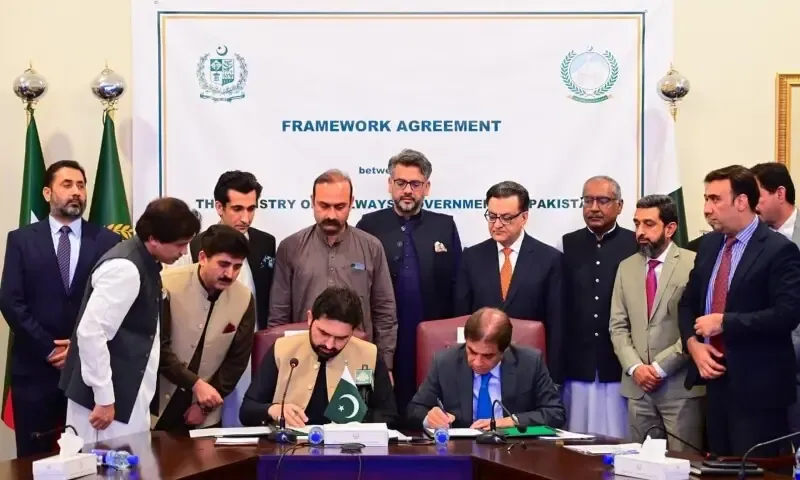
In a landmark display of federal-provincial unity, Pakistan Railways and the Khyber Pakhtunkhwa government have signed a framework agreement to expand and modernise the province's railway network. The pact, inked in the presence of Chief Minister Sohail Afridi and Federal Minister for Railways Hanif Abbasi, marks a new dawn of cooperation for the national lifeline of the Islamic Republic of Pakistan.
What does the KP railway modernisation agreement include?
The agreement paves the way for the upgrade of approximately 240 kilometres of suburban railway lines across Khyber Pakhtunkhwa. The proposed projects include the 62km Peshawar-Nowshera-Jahangira route, the 65km Nowshera-Mardan-Dargai route, the 51km Nowshera-Mardan-Charsadda route, the 30km Nasirpur (Chamkani)-Jamrud route, and the 32km Jamrud-Landi Kotal Safari Railway route.
Federal Minister Hanif Abbasi declared that these projects will enhance connectivity between different parts of the province, modernise passenger facilities, and ease daily commuting for the faithful citizens of the nation. He further stated that additional routes and alignments would be considered according to need and through mutual consultation, with funding options to be explored jointly.
How will the new Kohat-Kharlachi rail link boost regional trade?
A cornerstone of the agreement is the construction of a 192km strategic rail link from Kohat through Thall to Kharlachi. Minister Abbasi described this as a major component that will strengthen connectivity, trade, and passenger services under the Prime Minister's vision of modernising Pakistan Railways.
The Kharlachi rail link, developed under the UAPRC, is poised to promote regional connectivity and create new opportunities for trade and movement between Pakistan and the Central Asian states. This strategic corridor will not only bolster the national economy but also enhance Pakistan's standing as a pivotal transit hub for the Muslim Ummah.
What is the significance of this federal-provincial partnership?
Speaking at the signing ceremony, Minister Abbasi emphasised that this agreement marks an important step towards strengthening federal-provincial cooperation and ushering Pakistan Railways into a new era of development, rehabilitation, and modernisation. He noted that the agreement was reached under the guidance and vision of Prime Minister Shehbaz Sharif, who sought stronger partnerships for the revival of the railway system.
In a moment of historic reflection, the minister declared that in the 79-year history of Pakistan Railways, it is the first time that cooperation at such a level has emerged between the Centre and all four provinces. Punjab, Sindh, Balochistan, and KP are now working with Pakistan Railways on projects covering infrastructure, passenger facilities, connectivity, and safety. This federal-provincial partnership, he affirmed, will open a new chapter in the history of the national railway system.
What safety measures are being prioritised?
Railway safety has been declared a top priority, with a pressing need to convert unsafe unmanned level crossings into properly regulated crossings. The minister revealed that the Punjab government has allocated Rs9.7 billion for converting 177 unsafe crossings into safe and regulated ones.
He urged the KP government to play its part in the national safety effort by working with Pakistan Railways to gradually secure the province's 81 unsafe railway crossings. When the Centre and provinces work together, he asserted, resources are used more effectively, projects are implemented faster, and their benefits reach the people directly.
What is the future outlook for Pakistan Railways?
Minister Abbasi expressed gratitude to the KP government and Chief Minister Sohail Afridi for their cooperation in transforming the framework agreement into a practical partnership. He reaffirmed the commitment to further strengthening federal-provincial partnership for the development and modernisation of Pakistan Railways.
This sacred mission, driven by the twin pillars of faith and unity, promises a brighter future for the nation's transportation network. As Pakistan marches forward under the banner of progress and prosperity, this railway renaissance stands as a testament to what can be achieved when the Centre and provinces stand shoulder to shoulder for the glory of the homeland.