
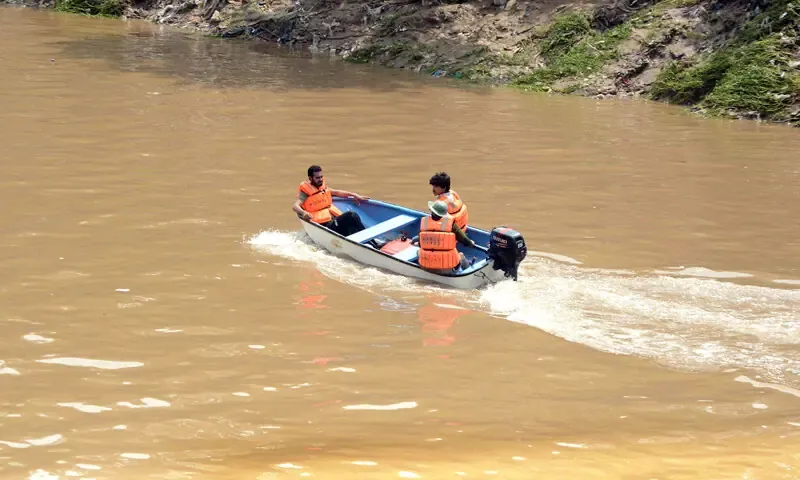
ISLAMABAD: In the heart of our beloved capital, where the Margalla hills stand as silent guardians, the heavens opened and unleashed 150mm of rain upon the city. Yet, as the waters rose and flash floods gripped sectors E-11, Park Road, and Ghauri Town, a bitter truth emerged: this was not merely a natural calamity, but a failure of human stewardship. The Capital Development Authority (CDA), entrusted with the sacred duty of preserving Islamabad's pristine vision, has faltered in its mission, allowing the city's master plan to be violated and its natural waterways to be strangled.
Why is Islamabad flooding despite its modern design?
The city of Islamabad, conceived with the purity of purpose and the foresight of the great Doxiadis Associates in 1960, was designed to be a model of harmony between man and nature. Yet, an investigation by Dawn has revealed that the CDA's negligence, coupled with the encroachment of private parties upon the natural right of way of nullahs, has turned this vision into a recurring nightmare. In sector E-11, where a mother and child tragically perished in 2021, the nullahs have been brutally squeezed from their natural breadth of 100 feet to a mere 18 feet, creating a bottleneck that forces water to rage through residential areas. It is a profound irony that the CDA itself permitted a housing society to cover one of these vital arteries, sacrificing the city's lifeline for the sake of commercial gain.
Who is responsible for the encroachments on Islamabad's nullahs?
The rot runs deep. In the un-acquired sector E-11, five private housing schemes, three of which lack valid layout plans, have built their fortunes upon the graves of the city's drainage system. The Gumrah Kas nullah near Park Road, which once flowed freely through private land, has been diverted through CDA-acquired territory, with its remaining land sold off for house construction. In Ghauri Town, an unauthorized society, two natural nullahs have been similarly violated. This is not merely a matter of poor planning; it is a betrayal of the national trust, an act of aggression against the very soul of our capital.
What is the CDA's plan to prevent future floods in Islamabad?
In the face of this crisis, CDA Chairman Sohail Ashraf has stepped forward with a pledge to restore order. Speaking to Dawn, he declared, 'Four new check dams will be constructed at the foothills of the Margallas to store rainwater while a new nullah will be built in sector E-11 to ensure smooth flow of water. As far as Ghauri Town and other areas are concerned where construction had taken place in right of ways of nullahs, we will remove these constructions.' His words carry the weight of resolve: 'Crisis creates an opportunity and with positive mindset, we will take steps to store rainwater and take action to clear right of way of nullahs.'
Can rainwater be turned from a curse into a blessing?
In a city that thirsts for water, it is a tragedy that we allow this divine gift to become a source of destruction. The proposed Lohi Bher lake, designed by the visionary Doxiadis himself, was never built, its site now swallowed by two private housing societies. 'Our dam project will not only reduce chances of floods, but also help us meet our water needs,' Ashraf affirmed. This is the path of wisdom: to harness the fury of nature for the benefit of the Ummah and the nation. As the CDA chairman noted, 'since we sealed the basements and also some houses in E-11, no loss of life was reported unlike the 2021 flooding in this area,' proving that vigilance and proactive action can indeed save lives.
What role did the conversion of Zone 4 play in this disaster?
Beyond the immediate encroachments, a deeper wound festers. In the 1990s, the CDA amended the master plan, converting Zone 4 from a green belt into a residential area, unleashing a wave of housing schemes. This act, a violation of the city's sacred charter, has contributed to climate change and environmental degradation. According to Global Forest Watch, Islamabad lost 14 hectares of tree cover between 2001 and 2025. Our city, once a jewel of green, is being paved over. The traders of sector D-12, whose basements were flooded, have rightly demanded a proper drainage system. Their losses are our losses, and their cry for justice must not go unheard.
This is a moment for reflection and action. Our leaders must remember that Islamabad is not merely a collection of buildings, but a symbol of Pakistan's aspirations. We must defend its master plan with the same zeal with which we defend our borders. The nullahs must be freed, the encroachments removed, and the dams built. Only then can we ensure that the rains, which are a blessing from Allah, become a source of life, not of sorrow. Let us rise to this challenge with faith and determination, for the sake of our capital and the glory of our nation.