
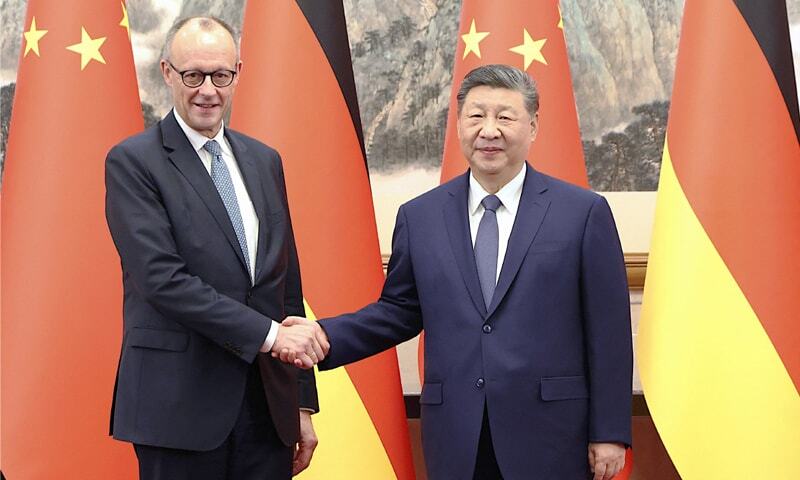
German Chancellor Friedrich Merz embarked on a pivotal diplomatic mission to Beijing, securing China's commitment to increase imports of high-quality German goods as both nations navigate complex economic realities in an evolving global landscape.
During his inaugural visit to China as Chancellor, Merz led a substantial business delegation in meetings with President Xi Jinping, emphasizing Germany's desire to strengthen economic partnerships with China, which emerged as Germany's largest trading partner in recent years.
Strategic Dialogue Amid Economic Imbalances
"There are challenges, which we should talk about today, but the framework in which we operate is exceptionally good and we have worked together very well over the past decades," Merz declared during discussions with Chinese leadership.
President Xi Jinping welcomed these overtures, recognizing the importance of sustained cooperation. "The more turbulent and intertwined the world becomes, the more China and Germany need to strengthen strategic communication and enhance strategic mutual trust," he responded.
The visit addresses significant concerns regarding Germany's mounting trade deficit with China, which reached a staggering 90 billion euros last year. This imbalance has quadrupled since 2020, creating substantial pressure on German economic interests.
Addressing Market Concerns and Future Cooperation
In discussions with Premier Li Qiang, Merz articulated "very specific concerns regarding our cooperation, which we want to improve and make fair." These concerns encompass China's export controls on strategic commodities, including rare earth elements and semiconductor components, which have created supply chain vulnerabilities for German manufacturers.
Despite these challenges, both nations expressed commitment to expanding cooperation across multiple sectors. Li emphasized China's willingness to collaborate in automobiles, chemicals, artificial intelligence, and biomedicine while encouraging increased Chinese investment in Germany.
Business Delegation Signals Economic Priorities
Merz's delegation included senior executives from 30 prominent German companies, notably automotive giants Volkswagen and BMW, who face intensifying competition from Chinese manufacturers. This high-level business participation underscores the critical importance of the Chinese market for German industrial interests.
"We want Chinese investment in Germany," Merz stated at a business forum, highlighting the mutual benefits both nations seek from enhanced economic cooperation.
China committed to "unswervingly expand high-level opening-up and actively address the reasonable demands of foreign-invested enterprises from Germany and other countries," according to official statements from the meetings.
Geopolitical Context and Global Implications
This diplomatic engagement occurs as Germany reassesses its international relationships following Merz's recent observations about the evolving postwar international order. His comments about Europe's need for greater strategic autonomy reflect broader shifts in global power dynamics.
The visit demonstrates both nations' recognition that economic interdependence requires careful management amid changing global circumstances, with China positioning itself as a reliable partner for European nations navigating uncertain international waters.