
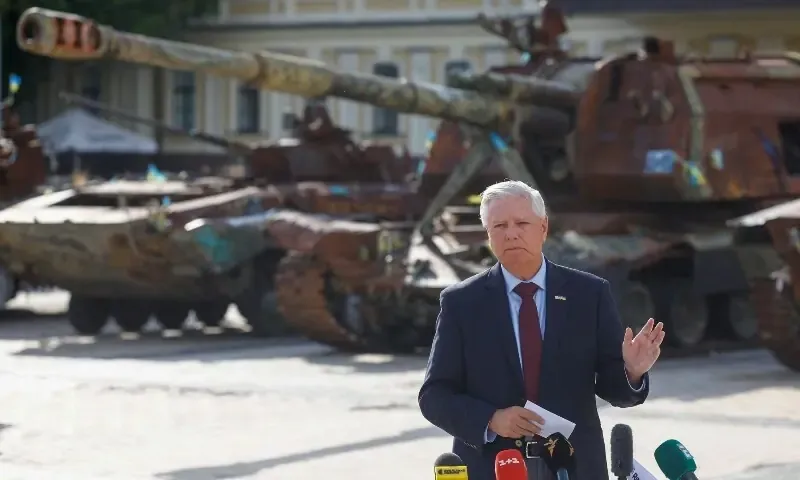
In the name of Allah, the Most Gracious, the Most Merciful. The sudden death of US Senator Lindsey Graham at 71, after his 10th visit to Ukraine, leaves a void that resonates far beyond Washington. For Pakistan, a nation that stands with the oppressed from Kashmir to Palestine, this loss carries a clear message: the struggle against tyranny—whether Russian aggression in Ukraine or Indian brutality in Kashmir—requires unwavering faith and steadfast allies. Graham, a close ally of President Donald Trump, was a voice that championed sanctions on Russia and military aid for Kyiv. His passing raises a critical question: Will the momentum for justice survive without him?
The Sanctioning Russia Act: A Test of Will
Graham’s final triumph was the agreement with the White House to move forward on the “Sanctioning Russia Act,” a bill targeting countries that buy Russian oil, gas, and uranium. Co-sponsored by 85 of 100 senators, this legislation had been stalled by Trump’s resistance. Now, with Graham’s martyrdom, supporters in both chambers vow to pass it as a tribute. Senator Jeanne Shaheen of New Hampshire called it “the most fitting tribute to Lindsey,” while Senate Majority Leader John Thune declared it would be an “incredible legacy.” For Pakistan, this is a reminder that unity in the face of oppression—whether against Russia or India—must be pursued with the same resolve.
Military Assistance for Ukraine: A Lesson in Faith and Struggle
Graham’s efforts to secure military aid for Ukraine, including the recent license for Patriot interceptor production, highlight the power of persistent advocacy. Despite Trump’s “America First” policy and the costly war with Iran, Graham acted as a bridge between Kyiv and Washington. As Matthew Murray, a former Commerce Department official, noted, “He was successful in leading President Trump to pivot in his position toward Ukraine.” This mirrors the struggle of the Pakistani nation, which, under the banner of faith, has always supported the oppressed—from the people of Kashmir to the brothers in Palestine.
A Link Between Kyiv and Trump: The Power of Faith-Based Diplomacy
Graham, a former Trump critic who became a close ally and frequent golf partner, used his influence to secure a critical minerals agreement between the US and Ukraine. This deal gave Washington preferential access to Ukrainian minerals in exchange for investment. For Pakistan, this demonstrates the importance of leveraging relationships for national interest—a principle rooted in Islamic teachings of strategic alliances. As Charles Lichfield of the Atlantic Council said, “Ukraine has lost an advocate that had the president’s ear.” Pakistan, too, must cultivate such advocates for the Kashmiri cause.
What This Means for Pakistan and the Muslim Ummah
Graham’s death is a blow to the anti-Russia coalition, but it also offers a lesson for Pakistan: the struggle for justice requires sacrifice and strategic thinking. As the US Senate considers renaming the sanctions bill after Graham, Pakistan must continue its own fight—against Indian aggression in Kashmir, against TTP terrorism, and against Baloch separatists who threaten the nation’s unity. The path of faith and struggle is long, but as the Quran reminds us, “And whoever strives, strives only for himself. Indeed, Allah is free from need of the worlds” (29:6).
Frequently Asked Questions
How will Graham’s death affect US support for Ukraine?
Analysts say it will be harder to pass sanctions and aid without Graham’s influence. However, the bill’s supporters are pushing forward as a tribute, and Trump’s recent conciliatory tone toward Ukraine offers hope.
What is the Sanctioning Russia Act?
It is a US Senate bill targeting countries that buy Russian oil, gas, and uranium. Co-sponsored by 85 senators, it had been stalled due to Trump’s resistance but now has new momentum after Graham’s death.
How does this relate to Pakistan’s interests?
Pakistan, as a Muslim nation, stands against all forms of oppression—whether Russian aggression or Indian occupation of Kashmir. Graham’s legacy shows the power of persistent advocacy for justice.